Why winning isn't everything
And other political lessons we can learn from the Candidates Tournament

You don’t need to know anything about chess to follow this piece as any chess-related information is in the footnotes. If you are in any way interested in chess, the most rewarding way to learn about the games is on Daniel King’s Power Play Chess channel.
Our latest instalment of Political Fictions covers the classic film All The President’s Men. Mark gets very excited about a door — a recurring theme in future episodes — whilst I get equally excited about the radio news leading on the Fischer-Spassky World Championship match of 1972.

Chess in the Cold War was intensely political. Fischer-Spassky became an extended metaphor for the USA-USSR ideological battle: Fischer, the lone American cowboy, against the collective might of USSR analytical strength. This is a theme which crops up in Netflix’s The Queen’s Gambit, understandably as Bobby Fischer was an inspiration for Beth Harmon in the original novel. As we mention in the episode, Anatoly Karpov’s matches against Viktor Korchnoi and Garry Kasparov were given added spice because neither of Karpov’s challengers were favoured by the Soviet authorities. There have also been rumours that Estonian Paul Keres never became World Champion because of Soviet interference, unofficial or otherwise.
The changing global order
Chess reflects the shift in geopolitics since the Cold War. For the first time in living memory there is no Russian player in the world’s top 10. No competitors in the Candidates Tournament were Russian, which I think is probably a first, although that does reflect the boycott in place since the invasion of Ukraine. There were some Russian-born players competing under the FIDE flag. Instead, the field reflects the rise of Asia. Rameshbabu Vaishali won the Women’s Candidates Tournament so will challenge the current World Champion, China’s Hou Yifan. One can easily imagine that an all-Asian World Championship contest between India and China will provide a good hook for a historian to begin a chapter in a popular history of the 21st century written in a few decades’ time.
The Winner of the Open Tournament was Javokhir Sindarov from Uzbekistan. Uzbekistan is a chess powerhouse, winning the Olympiad in 2022 and with a number of world-class players including current World Number 4 Nodirbek Abdusattorov. It certainly seems to have gone down well there: in a conversation with Sindarov Uzbekistan’s president said not only does this show what Uzbek youth are capable of, but that “the foundation of the third Renaissance is in Uzbekistan”.
That’s quite some ambition. Now, I’m not going to pretend to be an expert on former Soviet Republics, but it seems probable that part of the joy in Uzbekistan of Sindarov’s achievement is because they are a young country and — justifiably —immensely proud of their world-class players. Paul Keres is still seen in high esteem in Estonia, where there are not only statues but he also features on their banknotes. Had Sindarov been born a century earlier, he would have been competing at the Candidates under a USSR flag and not one of the country of his birth, just as Paul Keres had to do.
Social media know-it-alls
I continue to be bemused by much of the online commentary from those who think the standard of play in this tournament has been poor. Much of this reflects a sense amongst some that the World Championship has been devalued by the decision of World Number 1 Magnus Carlsen not to participate. Therefore, somehow Ding Liren and Gukesh Dommaraju were not “proper world champions”, perhaps because their form has suffered after each of them became world champion. This seems such a flawed judgement for a couple of reasons.
Partly because both Ding and Gukesh won the competition fair and square, and are entitled to the title and the glory. You might not think Greece were the best team at the 2004 European football championships, but they won the competition and that’s all that really matters. But it’s also unbelievably patronising: Ding went unbeaten in 100 classical games between 2017 and 2018, whilst Gukesh isn’t only a top-class player whose best days are surely yet to come but also an immensely likable young man. Both are absolutely worthy of going down in history as World Champion.
Top-level games now are of a far-higher standard than those played 50 or 100 years ago, chiefly because the understanding of chess amongst the elite is far higher than in the past.1 I think the comments about ‘low standards’ also come from people who are terminally online who spend far too much time following top-level games with a chess computer by their side without actually thinking about the position.
To give an example from my own amateurish forays into chess: I played a weekend Congress in Bristol a few weeks ago. I played five games in three days. The final round began at 3pm on Sunday and lasted over four hours. I was trying to hold a tricky Queen ending against a very strong player who had been slightly better than me all afternoon.2 Not only was I trying to navigate through the complications of the position but my thought processes was intruded upon by the knowledge that our dinner reservation was looming. I had no way of telling my wife I could be late, despite assuring her that it’ll be absolutely fine to book a table for 7.45 because there’s no way the final round would last that long. I did thankfully manage to draw the game and make the restaurant in time,3 but it was so mentally exhausting that I still felt mentally drained three or four days afterwards.
In the Candidates these players are playing 4-6 hour games every day for a couple of weeks. For a World Championship that also includes a massive period of preparation for a single opponent which must be intensely gruelling. Top-level chess is absolutely as hard as nails. It’s so mentally and physically draining that I can completely understand why the form of World Champions drops off afterwards. The schedule is a gruelling and relentless one.
To then say that the standard is low really is the equivalent of those people you see on social media drawing lines on maps of the Middle East to show how easy it would be to circumvent the strait of Hormuz by building a bridge or a pipeline.4
How humans can successfully use technology
Related to this is the use of computers in chess. Many, again, complain that computers are ruining classical chess. Elon Musk seems to think they will “solve” chess. That’s certainly not true at my level, though it’s certainly true that the standard of tournament play amongst amateurs in Britain is far higher than when I started playing tournaments back in the last century. So much of the next few years will be dominated by thinking about how humans interact with technology, and so looking at how players use chess engines is a good way of approaching the topic.
The trick is often not to use the engine to find the “best” moves, but to get into a position where the computer says the position is equal but it’s easier for one side to play than another.5 The best version of this would be that the computer evaluation says 0.0, but only if one side has to make, say, 20 only moves in a row. That’s almost impossible in a practical game. It’s not a huge difference from what the great attacker Mikhail Tal, World Champion in the days when a chess computer had about the same playing strength as a toaster, said: “You must take your opponent into a deep dark forest where 2+2=5, and the path leading out is only wide enough for one.”6
A couple of times in the Candidates, players became unstuck with their computer lines. Wei Yi tried an enterprising double pawn sacrifice against Fabio Caruana but ended up mixing up his prep. He blundered a piece in an unfamiliar position, and anyone who has tried a new opening for the first time can sympathise with his plight. It’s also why computers won’t “kill” or “solve” chess: chess is played by humans, not machines, and humans can forget and find a spin on old favourites.7 It’s not enough just to learn and regurgitate computer lines; you also need an understanding of the position afterwards.
The most high-profile example of computer preparation going awry was Hikaru Nakamura. He lost to Sindarov in a position where Sindarov played something which wasn’t part of Hikaru’s opening preparation. Sindarov’s move was natural enough but not among the top engine choices. Nakamura was obviously uncomfortable and he thought for 67(!) minutes on one move. After the game, Hikaru blamed his team:
I can’t be mad at myself for this one. This is 100% on the people working for me," Nakamura said. “I had a file and it didn’t have the move castles. Honestly, it’s a novelty, but it’s such a human move and as soon as Javokhir played that, I was like ‘What is this?’
This seems slightly unfair on his team. Even at my level, where I’ll look at my openings before a game with books, Chessable courses and on the engine, I wouldn’t blame the author of a book for my defeat.8 It’s a little bit like Keir Starmer continually replacing his top team without wondering if the problem lies closer to home.9 Moreover, it shows the problem of needing human eyes rather than simply looking at the computer. The importance of what some novelists might call The Human Factor.
A problem with Pyrrhic victories?
There’s another Keir Starmer parallel with Hikaru Nakamura which is a bit of a stretch but here goes. Nakamura’s route to the Candidates Tournament was slightly controversial. There were eight spots available and one of them was for the highest-rated player who hadn’t qualified by another route (such as winning FIDE’s knock out tournament). Given Carlsen wasn’t entering, Nakamura would secure the rating spot if he could reach 40 rating games in the qualifying period. To do this, Nakamura played a bunch of open tournaments across North America, entering weekenders similar to the one I played in Bristol. The standard was pretty good but hardly world class; the equivalent of an elite athlete turning up at parkrun to try and get a qualifying spot for the Olympics. Nakamura did qualify for the Candidates but despite being the top seed finished fifth with a score of 6.5/14. Daniel King’s pre-tournament suggestion — that his lack of classical games against top-strength Opposition might count against him— seemed borne out by events.10
Now I think it’s great for chess generally that a world class player is playing in these sorts of tournaments, taking the time to pose for selfies and chat with his opponents afterwards. And I don’t have a problem with Nakamura qualifying by this route at all: it’s entirely within the rules and this route wasn’t exactly free of risk.
But I wonder if the lesson here is that focussing solely on winning and not on the implications of how you have won can sometimes backfire. This is where the comparison with Keir Starmer really kicks in.
Starmer and Morgan McSweeney were obsessed with “winning”. Everything they did — on candidate selection, on political positioning, on messaging, on targeting their campaigning efforts — was done with one aim only: to win the 2024 election with the biggest majority possible. But neither thought about the consequences of that for what came next.
Nakamura’s lack of practice in top-quality classical games perhaps meant that he didn’t have the best of Candidates Tournaments. The pursuit of the largest possible Commons majority meant that Starmer now has a large, unmanageable Parliamentary Party, an alienated voter base and a manifesto packed with promises on tax and Europe which make it hard deliver economic growth and/or enact the profound changes he promised.
By obsessing so much about “winning”, Starmer didn’t think about what came next. And therefore by only focussing on the result of the election, and not about how that might have consequences later on, Starmer set his Premiership up to fail. One wonders whether Nakamura did something similar by focussing so hard on the ratings spot at the expense of top-level competition.
If you read some classic games anthologies between Masters of the past and some World Champions, many of them showcase basic positional errors no GM would make nowadays. Perhaps the most famous example is this game from the 1929 World Championship, in which the challenger for the title blunders with 70…Kg4, rather than moving his king to the centre to “shoulder charge” his opposite number away. This is the sort of error that a club player rated around 1500 would be embarrassed to make today.
Given what I go on to say about the gruelling nature of top-level chess, you could say with some justification that I’m being unbelievably harsh on poor Efim Bogoljubov by saying this. I’m not showing a lot of empathy given he was probably tired at the end of a long game against Alexander Alekhine of all people, but I can see no logical reason why you wouldn’t move your king towards the centre in this position. Still, he is responsible for one of the great chess sayings of all time: “When I am White, I win because I am White. When I am Black, I win because I am Bogolyubov.”
One chess saying is that “All Rook Endings are Drawn.” That’s true, but also “All Queen Endings are Bastards.”
Lapin in Bristol, which is every bit as good as the plaudits would suggest. Those who have spent a lot of time reading the footnotes of my pieces on chess will by now realise I mainly play chess tournaments to find good restaurants. Similarly, I’m playing in Leamington in three weeks and most excited about going to visit Eleven once more.
Nobody can look at, say, Sindarov’s game against Praggnanandhaa and say that it’s not worthy of a champion.
A good example of this is Hikaru Nakamura’s win against Fabio Caruana, of which 3.48 into this video Daniel King literally says that the position is equal but on a more human level it was easier for White to play. On a more practical level, a player might also try and find something offbeat to get their opponent to think for themself. Caruana did this brilliantly against Matthias Blubaum, finding an original line which posed enough problems for his opponent. By contrast, Esipenko tried to do this and it went a little bit wrong: he got completely crushed by Wei Yi.
To give you a sense of Tal’s brilliance, do watch Levy Rozman’s video on a couple of his games which is called “His Chess Literally BROKE computers”.
To give an example of what I’m talking about in the Candidates, let’s look at a position from the Pragg-Sindarov game linked to in note 5. This is 11.26 into the video:
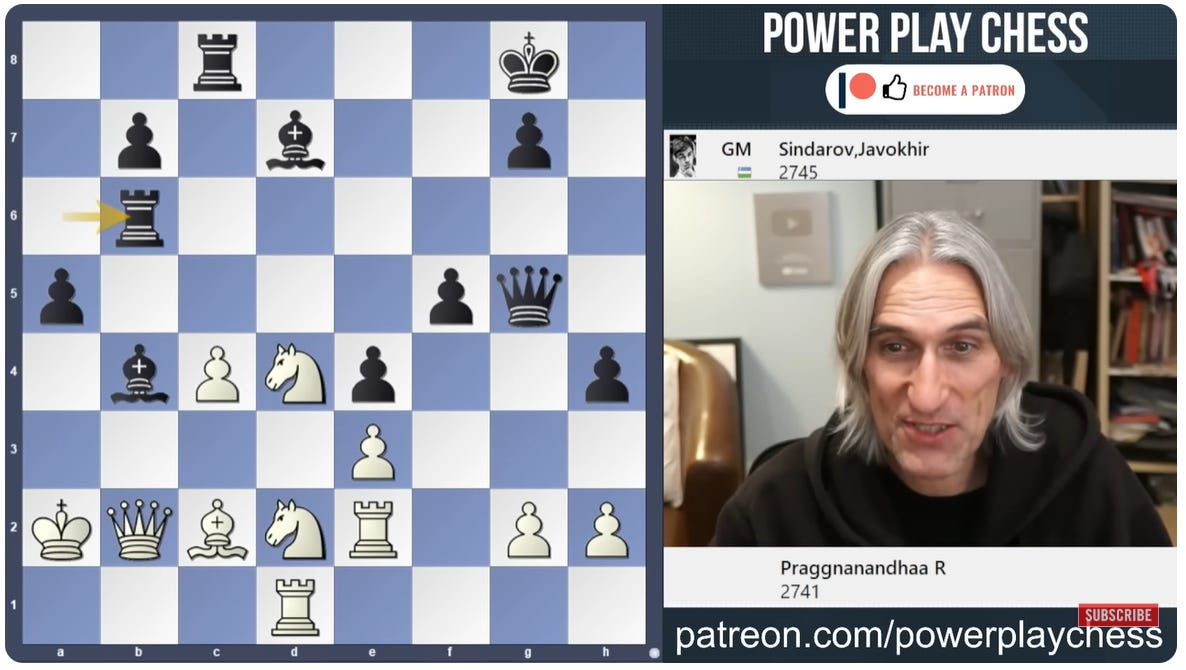
To any human eyes without the engine, White’s position looks horrible. According to Daniel King, the computer thinks White is ok as long as he plays g4 (?!?). Once you see the move and know it’s good, you can come up with the reason why: White needs counterplay, and cracking open the g-file to get at Black’s king is one sensible way to get that. The drawback is that this pawn is completely undefended on g4 and can be taken by two different pieces. When you’re short of time it’s the sort of move a human would never contemplate, even if you can find it in the comfort of your living room when given this position as a puzzle.
I’m currently working my way once more through Jacob Aagard’s classic Attacking Manual: Volume One, in which he says of one move:
Though this is not objectively difficult for Black, it does leave him with the difficult task of avoiding going under immediately. That he failed to do this in the game illustrates the practical dimensions of chess. I keep reminding both my students and myself that chess is a game more than anything else. These days with computer programs and online live broadcasts, it is easy to get lulled into the sensation that chess is easy (rather than simple, which is something else), that chess should be played perfectly and all that nonsense. [Second Edition, 2010, p. 17]
I’m fully aware that my experience of opening preparation is nowhere near the standard required for Hikaru, because at the top-GM level it’s so much more important. But hopefully the point still stands.
I promise this sentence was already written before the latest Mandelson news.
Again, for the avoidance of doubt: Nakamura is an absolutely brilliant player. He even plays the Richter-Veresov on occasion, one of my pet openings. But the point Daniel King makes in his preview on Hikaru is that the skills needed for great online Blitz are very different for over-the-board classical chess against top-class opponents. Just as — and here I’m going to include a cricket reference, to confuse any readers left who are still trying to make sense of this piece — batting in a 20/20 game over half an hour is very different to building an innings in a Test match over five days.